

How Much to Raise: Sizing Your Round
 Sergio JimenezSeptember 29, 20265 min read

Almost every conversation about a round starts with the number: "we're raising a million." That's the wrong order. The amount isn't a starting point, it's an output: it comes from what you have to prove before the next round, what proving it costs, and how long it takes.
This is the second article in the series. If you're not yet clear on what kind of fund you're talking to, start with The Types of Venture Capital Funds, Explained (/the-types-of-venture-capital-funds-explained): fund size dictates the cheque size a firm can write, and that shapes the conversation before it begins.
Start with the milestone, not the number
A round buys time to reach a point where the company is clearly worth more than it is today. That point is the milestone, and it's the only thing that justifies the next valuation.
The milestone has to be concrete and verifiable from the outside. "Grow a lot" is not. "Go from 15,000 to 80,000 in monthly recurring revenue with churn under 2%", "close ten paying customers in industrial manufacturing", "finish the preclinical study and file the dossier" are.
The practical rule: write the headline of your next round's deck. Whatever you need for that headline to be true is what this round has to fund. No more, no less.
The calculation, step by step
Once the milestone is defined, the number almost writes itself:
- Build the hiring and spending plan needed to reach the milestone. People first — in most startups that's 70-80% of spend.
- Work out the resulting net monthly burn, month by month, not as an average. Burn grows as you hire.
- Add up the months to the milestone.
- Add the time the next round takes. Raising costs three to six months from first meeting to money in the bank, and that's in a normal market.
- Add a buffer of 25-30% on top. The plan will not go to plan. It never does.
An example. You want to go from 15,000 to 80,000 in MRR. You estimate you need two more engineers, a sales hire and a marketing budget: burn goes from 35,000 to 60,000 a month over the period, averaging around 48,000. You reckon twelve months to the milestone, plus five months of raising: seventeen months. 17 × 48,000 = 816,000. With a 25% buffer, a little over a million. That's your round — and now you can defend where every euro comes from.
Why 18-24 months
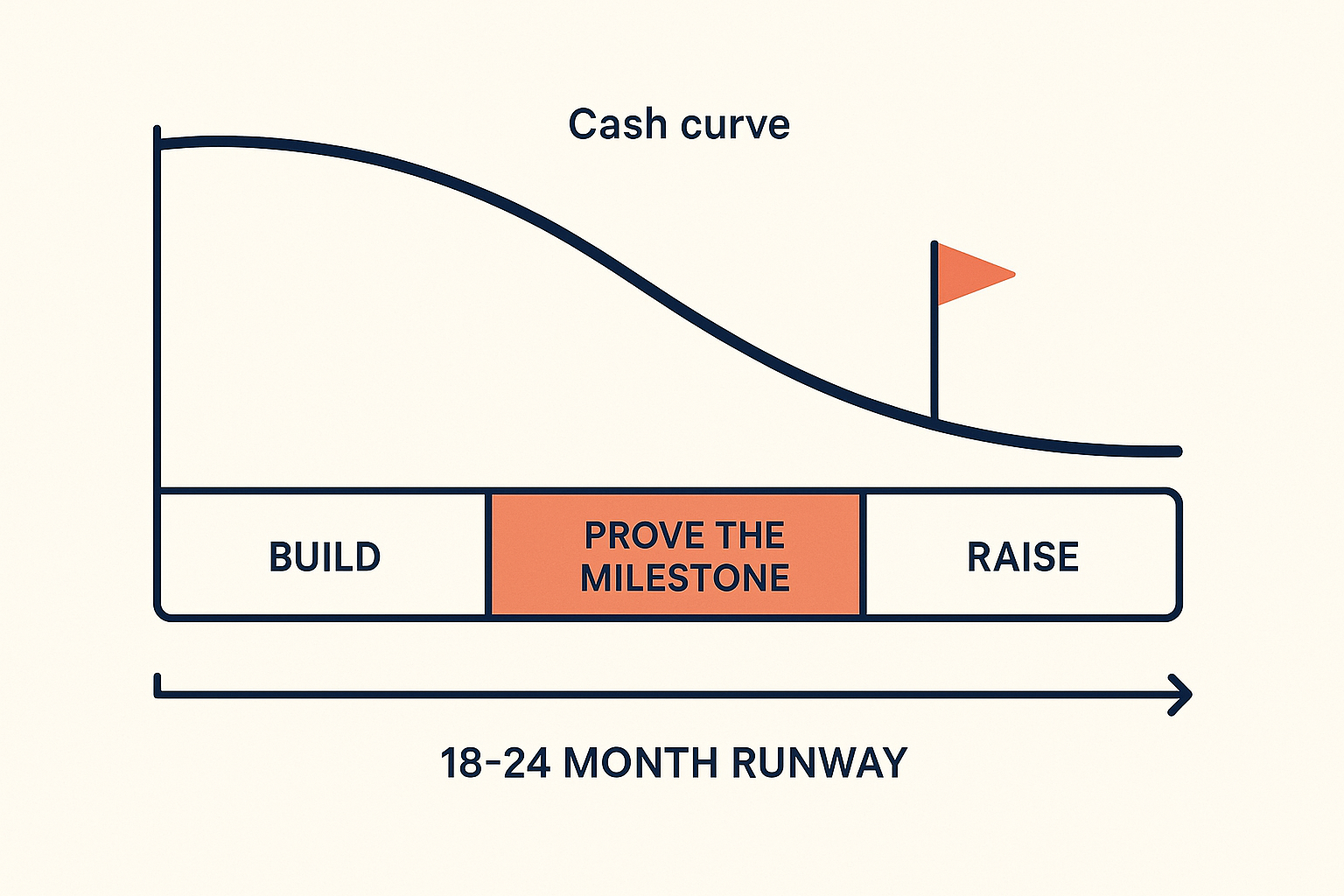
It's the standard reference for an arithmetic reason, not out of habit. With twelve months of cash you're raising from day one and negotiating with a gun to your head: any investor who senses urgency will use it on price and on terms. With more than thirty months, you're paying dilution today for money you won't touch for two and a half years, by which point the company will be worth more.
Eighteen months is the comfortable minimum; twenty-four leaves you room for the plan to slip once and still go out to raise from a position of strength.
Dilution sets the ceiling
The bottom-up calculation gives you the number you need. Dilution tells you whether it's a sensible one.
In a normal round between pre-seed and Series A, expect to sell 15% to 25% of the company. Below 10%, many funds won't participate: the position is too small for the return they need. Above 30%, you start building a cap table problem that shows up two rounds later, when there's no equity left for the founding team or the employee pool.
That turns the number into an implied valuation: if you need a million and sell 20%, you're asking for a five million post-money. The next question is whether your current metrics support that valuation in your market. If they don't, the problem isn't the valuation — it's that the milestone you picked is too expensive for the stage you're at. Shrink it.
Why raising too much makes your Series A harder
Raising more than you need looks free. It isn't.
First, today's valuation is tomorrow's bar. A twelve million post-money on 20,000 of MRR means the next round has to arrive with numbers that justify thirty or forty. If you don't get there, the alternative is a flat or down round, with everything that drags along: anti-dilution clauses triggering, a diluted team, and a terrible signal to the market.
Second, the extra money gets spent. Nobody hands back the surplus: you hire ahead of time, open a market you shouldn't have, and burn rises to meet the new cash level. When the plan slips, braking costs far more.
Third, the extra dilution never comes back. That additional 8% you sold cheaply at seed is still outside your cap table at Series C.
Raising too little is expensive too
The opposite mistake is just as common. A round that's too small leaves you in the same place twelve months later, with the same metrics and a worse story: you're no longer a new and promising company, you're a company that spent a year without moving the needle. And you pay the costs of the process again — founder time, legal, due diligence — to get very little, again.
Between two reasonable numbers, the larger one is usually right, as long as it still respects the dilution ceiling.
Talk in ranges, not in a single number
In meetings, don't give a closed figure. Give a range with logic behind it: "we're raising between 900,000 and 1.2 million; at 900,000 we reach the milestone, at 1.2 we do it with a quarter of margin and open the second customer segment." That shows you've done the exercise and leaves room for the round to grow if more demand turns up than expected.
And consider structuring a tranche: close a first part so you can start executing and leave a second open. It stops the full close from depending on the last investor to make up their mind.
Before you go out to raise
You should be able to answer these five questions without opening the spreadsheet: what the milestone is, what it costs to reach it, how many months of cash the round leaves you counting the next process, what percentage of the company you're selling and what valuation that implies, and whether your current metrics support that valuation.
If any of them comes back blank, the number isn't ready, and it will show in the first meeting. The amount you ask for is the first test of how you think about your own business: a round figure with no defence says one thing, and a range derived from a plan says something very different.
